
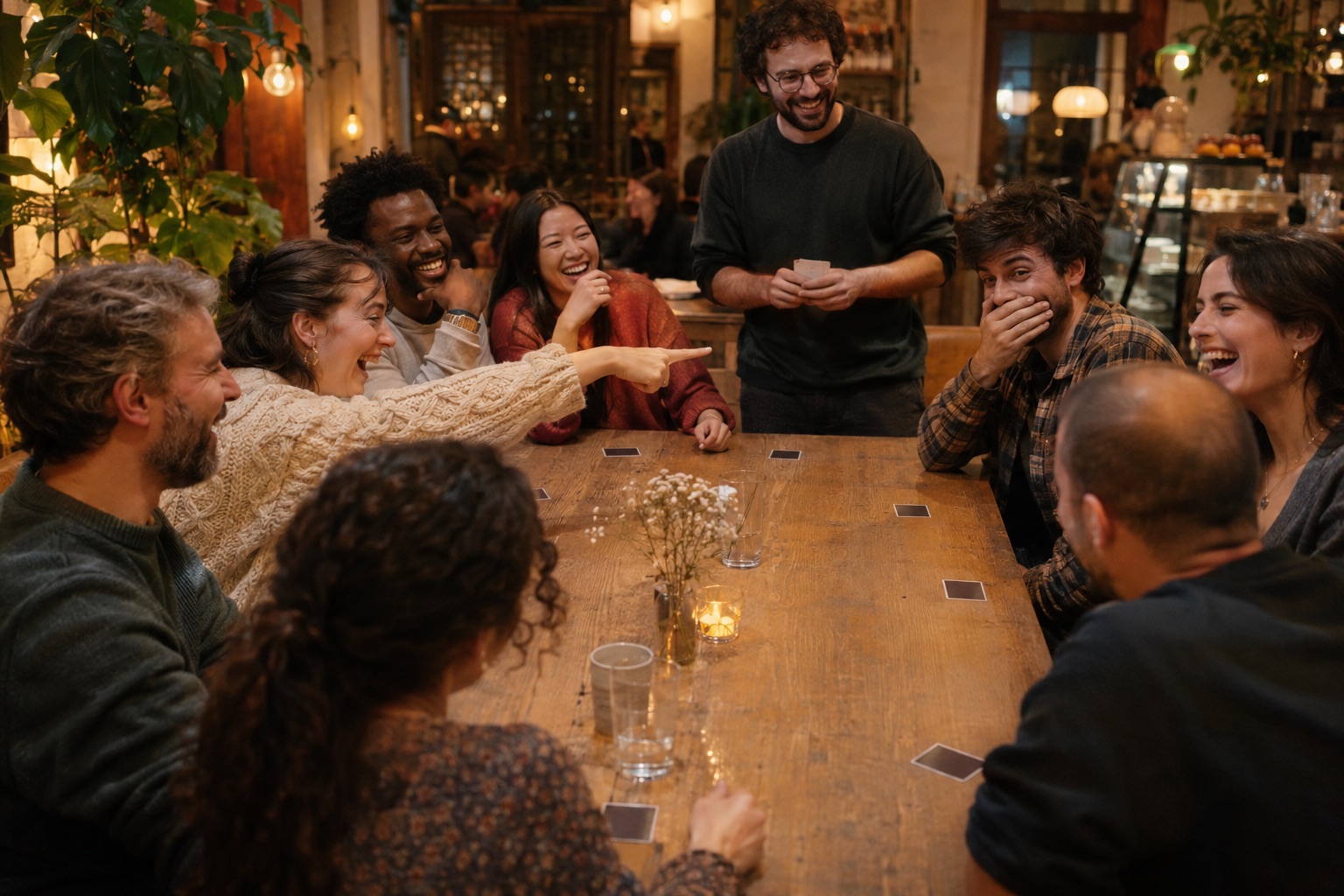
Where did the Mafia party game come from?
Mafia was created by Dimitry Davidoff, a psychology student at Moscow State University, in the mid-1980s. Most accounts date the first games to 1986, though some histories say 1987. He designed it partly as a way to study how people behave in groups, and it spread from his classes to student dormitories, summer camps and eventually around the world.
That origin explains a lot about why the game still feels so alive. It was built to put people in a room, give some of them a secret, and watch what happens to trust, persuasion and group decisions. Forty years later, that's still exactly what makes a Mafia night fun.
How does Mafia work?
The idea is simple. A small group of players are secretly the Mafia. Everyone else is a regular townsperson, and they don't know who the Mafia are. A host guides the game in two alternating phases:
1. Night. Everyone closes their eyes. The Mafia silently choose one player to remove from the game.
2. Day. Everyone opens their eyes and discusses what happened. Players accuse, defend, question and vote to remove someone they suspect.
The town wins by finding all the Mafia. The Mafia win if they survive long enough to match the town in numbers. Researchers describe it as an informed minority against an uninformed majority. In practice it's a room full of people trying to read faces, spot nervous laughs and argue their case, often with no evidence at all.
Davidoff's original rules didn't include special roles. Later versions added characters like a detective who can check one player each night, or a doctor who can protect someone. Those extra roles give quieter players a reason to pay close attention.
From Moscow dorms to Werewolf and The Traitors
The game travelled fast. It moved through Russian universities and summer camps, then reached other parts of Europe and the United States during the 1990s. In 1997, game designer Andrew Plotkin wrote a version with a werewolf theme, and "Werewolf" became its own branch of the family, especially popular at tech and gaming gatherings.
Today you can see Mafia's DNA in plenty of popular entertainment. Several writers have pointed out that the reality competition The Traitors is built on the same structure: a few secret traitors, a group of "faithfuls" trying to catch them, and a round-table vote every day. If you've watched the show and thought "I'd be terrible at that," a live game is a much friendlier place to find out.
Why does Mafia work so well for groups?
After hosting many games, we think the reasons are simple:
Everyone has to talk. You can't win as a silent player, so even shy guests end up speaking. The game gives them something specific to say.
It removes small-talk pressure. Nobody has to ask "So, what do you do?" The conversation is already happening.
It mixes people. Strangers end up allied, accused and laughing together within minutes.
It's memorable. People talk about who fooled whom for weeks. That shared story is what turns a table of strangers into a group.
It needs almost no equipment. Cards and a good host are enough. The host sets the pace, keeps it fair and makes sure the game stays fun rather than personal.
That's why we use Mafia for both social evenings and corporate events. A team that has argued, laughed and voted together over a game usually talks more easily the next morning.
Tips for your first Mafia game
If you've never played, a few things help:
Listen more than you talk in the first round. You'll learn how the group reasons.
Ask questions instead of making accusations. "Why did you vote for her?" reveals more than "It's you!"
If you're the Mafia, act normally. Overacting gives more people away than anything else.
Don't take it personally. Everyone gets accused eventually, and that's part of the fun.
Play with us in Langley
Get2Gether is turning two, and we're celebrating with an anniversary Mafia night on Friday, November 20, from 6 to 9 PM at Café Kolibri in Langley. Please note this game is hosted in Russian. Tickets are at go.get2gether.ca/buy/n3X7uU9_9i5Ys7ZJXShFnSevF9Ge-M_b. Another Russian-language Mafia night follows on Saturday, December 12, at the same café.
To learn more about the game or book a hosted Mafia evening for your team or celebration, visit get2gether.ca/experiences/mafia-game or our corporate events page at get2gether.ca/corporate-events.