Research · Sep 21, 2026
Why Networking Is Important: The Business and Personal Case, Backed by Data
Networking matters because opportunities, customers, hires and ideas travel through relationships — and because strong relationships are linked to longer, healthier lives. Here's what the research shows, plus a 30-minute weekly system.
Between 2015 and 2019, LinkedIn ran what MIT's Sinan Aral, one of the study's authors, calls the biggest long-term randomized test of weak ties ever run. Researchers randomly varied the connection suggestions shown to more than 20 million members over five years, a stretch in which those members formed 2 billion new connections and took 600,000 new jobs.
The result surprised a lot of people. The connections that produced the most job moves weren't close friends. They were acquaintances: people you share a moderate number of mutual connections with, or people you rarely message.
That's the business case for networking in one sentence:
Opportunity travels through people you don't talk to every day.
The personal case is just as strong. Since 1938, Harvard researchers have followed 724 participants and, later, 1,300 of their descendants. The people who ended up happiest, stayed healthiest into old age and lived longest were the ones with the warmest relationships.
Done well, networking isn't a sales tactic. It's how careers grow, how businesses find their best customers and how people stay healthy. Here's what the research shows, followed by a simple weekly system for acting on it.
Networking isn't what most people picture
Most people picture a hotel ballroom, a name tag and a stack of business cards. That's the least effective version. A better definition is that networking means building and maintaining relationships before you need them, so trust already exists when an opportunity shows up.
It helps to think of your network in three layers, each doing a different job.
- Strong ties are close colleagues, friends and trusted clients. Trust is high, but they mostly know what you know.
- Weak ties are acquaintances. Trust is lower, but they carry new information, introductions and opportunities you would never hear about otherwise.
- Dormant ties are people you were once close to but haven't spoken with in years. They combine the trust of a strong tie with the fresh information of a weak one, and most people ignore them completely.
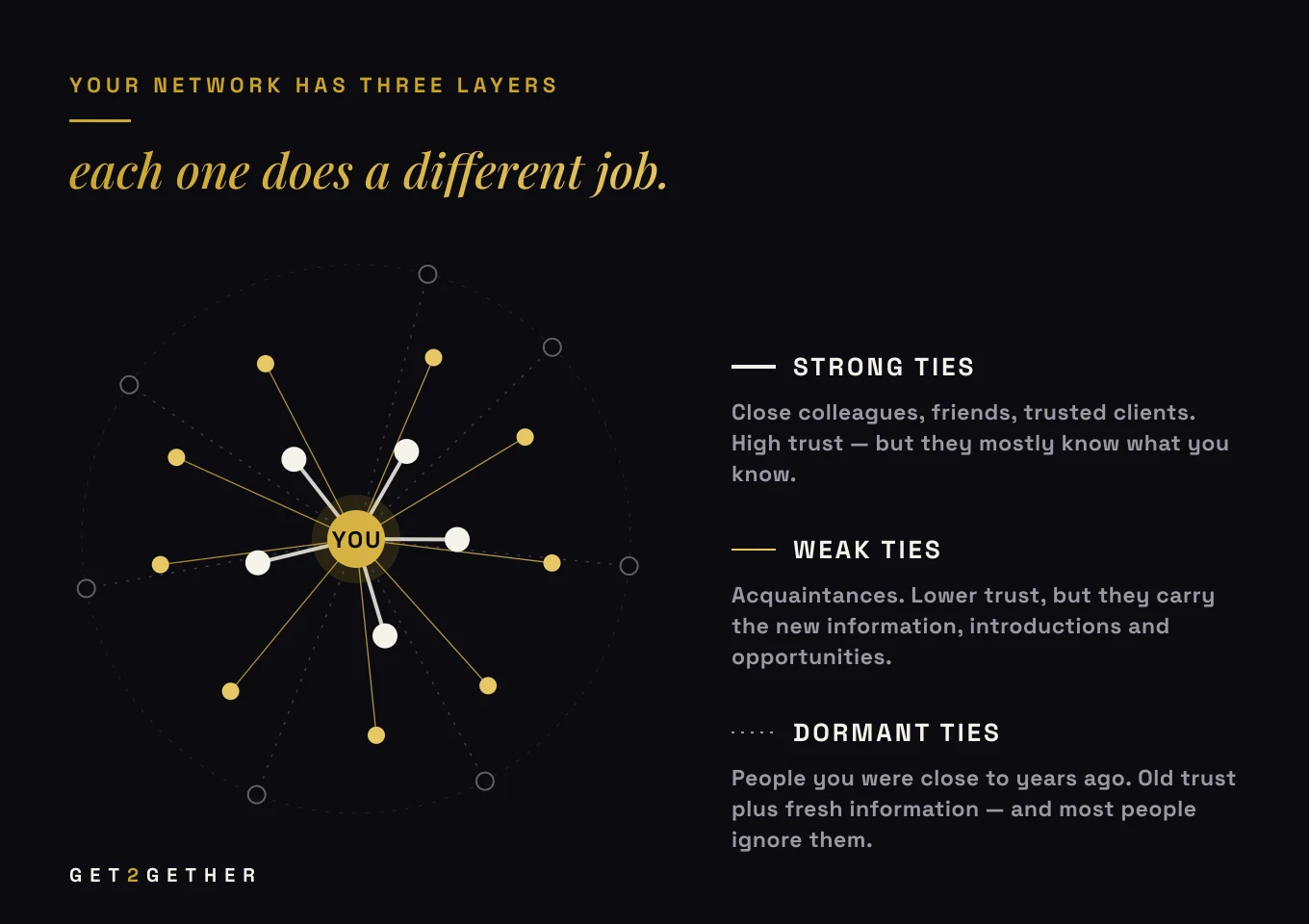
Each layer pays off in a different way.
The business case
Opportunities travel through acquaintances
Sociologist Mark Granovetter proposed the "strength of weak ties" in 1973. The LinkedIn study put that idea to a causal test and refined it. Weaker ties helped only up to a point, after which the returns tapered off. The effect also depended on industry: acquaintances drove more job mobility in digital-heavy sectors, while close ties mattered more in less digital ones. In software and other digital fields, breadth wins. In hands-on local industries, depth may matter more.
Referred customers are worth more
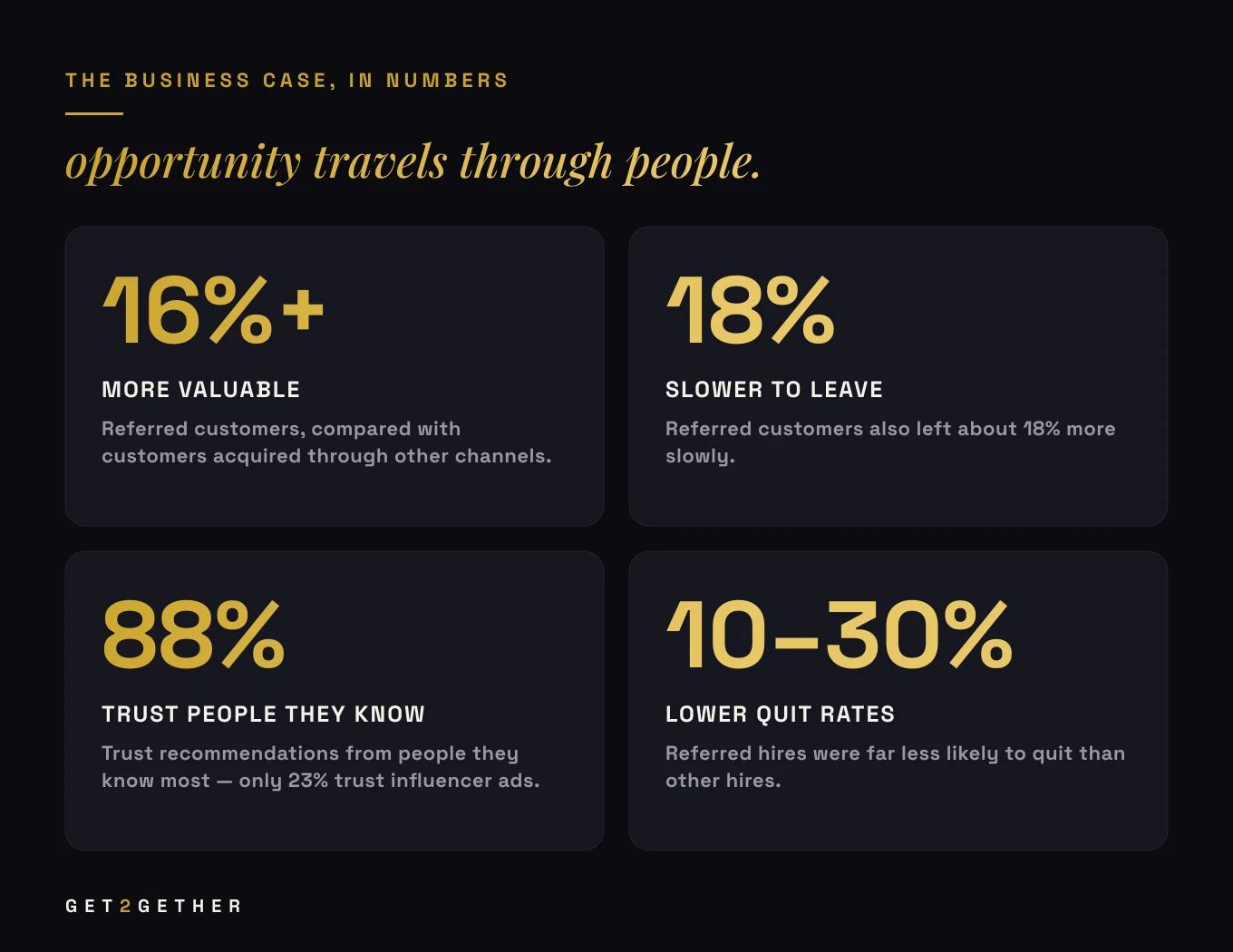
Researchers tracked roughly 10,000 customers of a major German bank for almost three years. Referred customers were worth at least 16% more than comparable customers acquired through other channels, and they left about 18% more slowly. The reason is trust. In Nielsen's 2021 global survey of 40,000 people, 88% said recommendations from people they know are the source they trust most. Only 23% said they trust ads from influencers. No ad budget buys what a warm introduction delivers.
Referred hires stay longer
A study of nine large firms in call centres, trucking and high tech found that referred applicants were more likely to be hired and to accept offers, and far less likely to quit. Where profit per worker could be measured, referred hires were substantially more profitable, mainly because of lower turnover and lower recruiting costs. An earlier version of the paper put the drop in quit rates at 10 to 30%. On a small team, where one bad hire can set you back months, that's a direct return on your network.
Better ideas come from the edges of your network
Sociologist Ronald Burt mapped the networks of 673 supply-chain managers at a major U.S. electronics company. Higher pay, stronger performance reviews, promotions and good ideas were concentrated among managers whose contacts bridged otherwise separate groups. These connectors were more likely to put ideas forward, less likely to have them dismissed and more likely to have them rated as valuable. In a separate study of automotive engineers, David Obstfeld found that engineers who habitually introduced colleagues to one another played a more central role in innovation. The person who connects two worlds sees options that neither world can see on its own.
Career growth compounds
One longitudinal study tracked salaries over three consecutive years. Networking was linked both to how much people earned and to how quickly their pay grew. A newer eight-year study by the same researchers, published in 2026, added nuance: men's salary growth benefited from networking inside their organization, while women's benefited from networking outside it.
The personal case
Relationships are a health metric
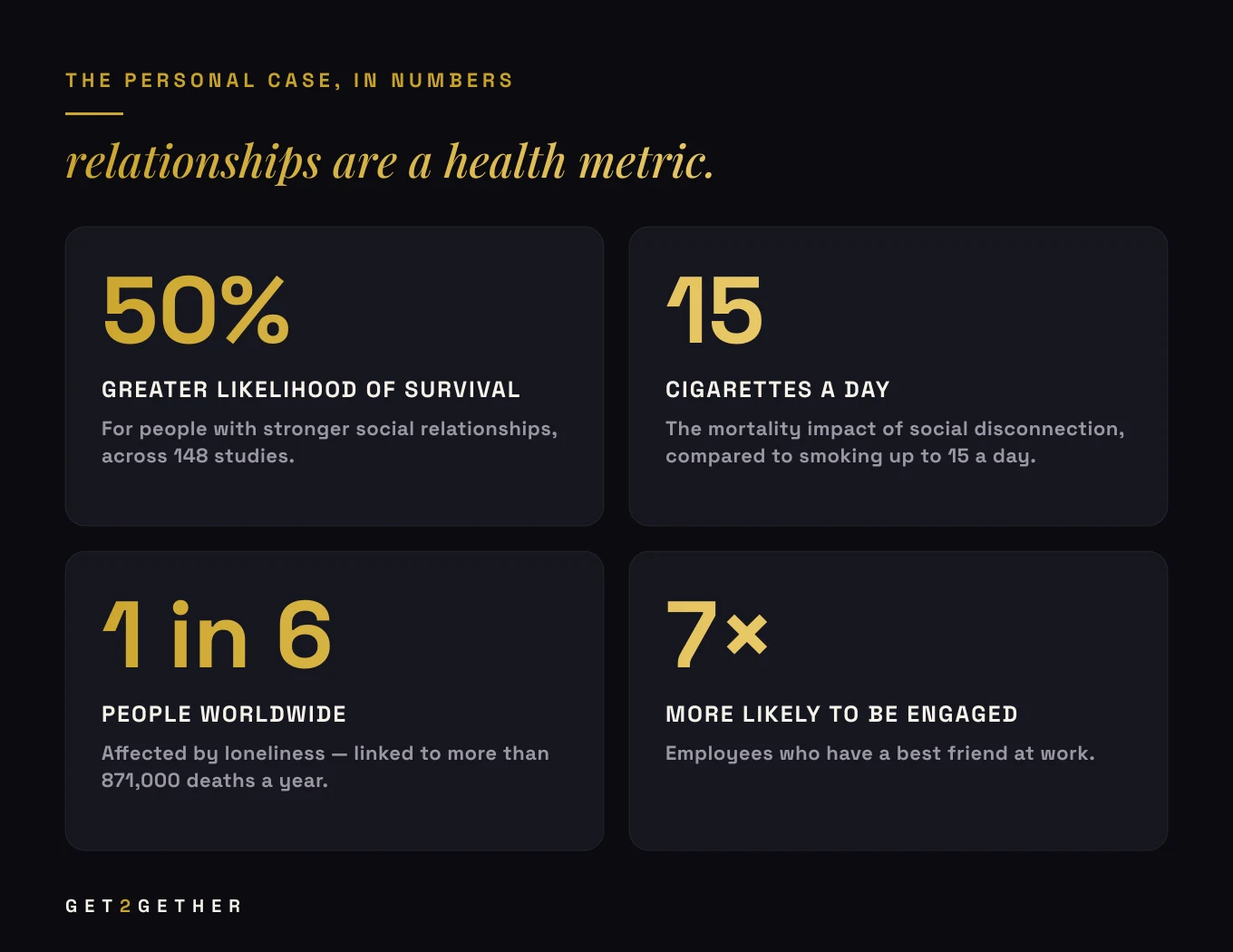
A meta-analysis of 148 studies covering 308,849 people found that those with stronger social relationships had a 50% greater likelihood of survival. The U.S. Surgeon General's 2023 advisory compared the mortality impact of social disconnection to smoking up to 15 cigarettes a day. It also tied disconnection to a 29% higher risk of heart disease, a 32% higher risk of stroke and a 50% higher risk of dementia. In 2025, the World Health Organization estimated that loneliness affects one in six people worldwide and is linked to more than 871,000 deaths a year, or about 100 every hour.
Happiness runs on connection
Robert Waldinger, who directs the Harvard study, has said one of its biggest surprises was that the relationships that make people happy are also what keep them healthy. Income and status mattered less than connection.
Work friendships change how work feels and how it performs
Gallup finds that employees with a best friend at work are seven times more likely to be engaged. Its meta-analysis of more than 180,000 teams suggests that doubling the number of such employees on a team could raise work quality by 24% and profitability by 12%, while cutting safety incidents by 26%. Yet in 2022, only about 2 in 10 U.S. employees said they definitely had one.
Leaders need a bench
Owners and executives are often the most isolated people in the building. In an RHR International poll of 83 U.S. CEOs, half reported feeling isolated in the role, and 61% of that group said it hurt their performance. Among first-time CEOs who felt that way, nearly 70% said it hurt their performance. A peer network of other owners who understand payroll pressure and hard decisions isn't a luxury. It's decision-making infrastructure.
Why networking matters more in 2026
Three shifts have made relationships more valuable.
Remote work shrank our networks
An analysis of 61,182 Microsoft employees found that company-wide remote work made collaboration networks more static and siloed, with fewer bridges between groups. The chance encounters that used to build networks now have to be created on purpose.
Trust is retreating into small circles
The 2026 Edelman Trust Barometer found that 70% of people are hesitant or unwilling to trust someone with different values, backgrounds or information sources. In Canada the figure is 73%. Only about a third say most people can be trusted. HR analysts tie the shift partly to fears about job loss, economic instability and being left behind by AI. When trust concentrates in personal circles, being inside someone's circle matters more, and people who can bridge circles become rare and valuable.
AI made outreach nearly free
Anyone can now send a thousand personalized-looking messages before lunch. When reach costs nothing, trust becomes the scarce asset, and trust still moves from person to person.
How to network without feeling like a salesperson
The research points to a practical playbook.
Give first, in five-minute increments
Adam Grant's research found givers at both the bottom and the top of the success ladder. In sales, the top performers were givers who averaged 50% more annual revenue than takers and matchers. The difference between the two groups is boundaries: the successful givers are generous without becoming doormats. Grant highlights networker Adam Rifkin's five-minute rule: be willing to do anything that takes five minutes or less for anyone. That could be an introduction, a quick review or a referral.
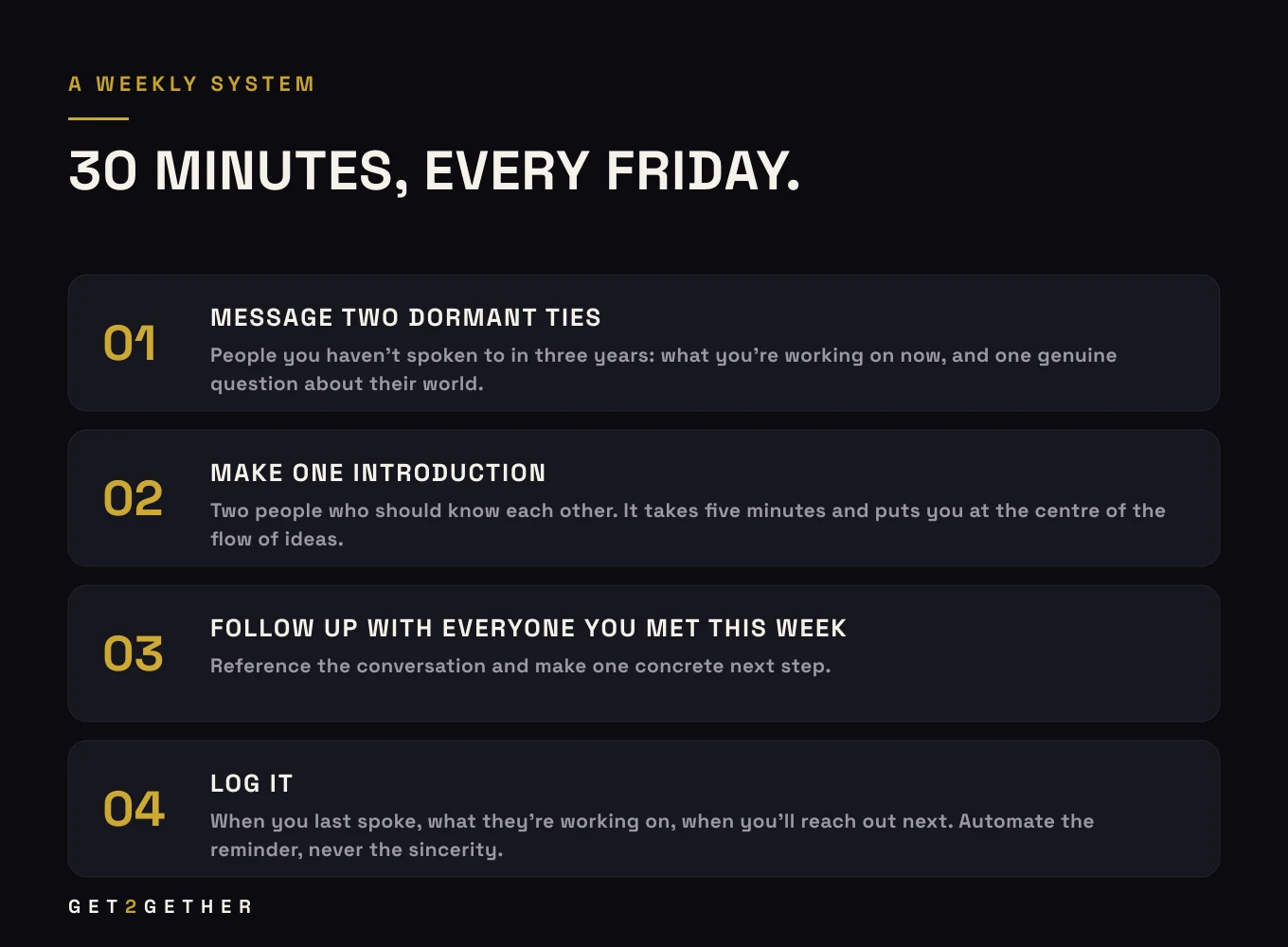
Reactivate two dormant ties a week
Research by Daniel Levin, Jorge Walter and Keith Murnighan shows that people you've been out of touch with for three or more years keep a residue of trust while bringing information your current circle doesn't have. When 116 executives contacted long-lost contacts for project advice, the tenth person on their list proved as valuable as the first. Most managers have at least a thousand such relationships. A short note works: say what you're working on now and ask one genuine question about their world.
Choose shared activities over mixers
Brian Uzzi and Shannon Dunlap's research shows that most personal networks are tightly clustered, and that strong, diverse networks are built through relatively high-stakes activities alongside people unlike you. Examples include nonprofit boards, charity drives and amateur sports leagues. Look for anywhere people work toward a shared goal and see how you operate under pressure.
Be the bridge
Make one introduction a week between two people who should know each other. It takes five minutes and builds your reputation. As Burt's and Obstfeld's work suggests, it also puts you at the centre of the flow of ideas.
Show up on a schedule
Consistency beats intensity. BNI, which describes itself as the world's largest business networking organization, reports 355,000+ members who passed more than 17.8 million referrals worth over US$26.9 billion in the 12 months to December 31, 2025. These are self-reported figures that BNI says should be treated as representative. Whether you join a referral group, a chamber or an industry association, the value comes from repetition.
Systematize the follow-up, not the relationship
For every key contact, keep a simple record of when you last spoke, what they're working on and when you'll reach out next. A CRM, a spreadsheet or calendar reminders all work. Automate the reminder, but never the sincerity. For the first 48 hours after an event, use the follow-up playbook.
Measure it like any other channel
Track meaningful conversations per week, introductions made, referrals received and revenue from referred clients. Within a quarter you'll know which rooms, groups and relationships are worth your time.
Automate the reminder, but never the sincerity.
The bottom line
Networking isn't a soft skill, and its returns are measurable. Referred customers were worth at least 16% more. Referred hires stay longer, connectors' ideas get rated higher and pay grows faster. Outside work, stronger relationships came with a 50% greater likelihood of survival. The payoff is slow and compounding, which is exactly why most people underinvest in it.
Start this Friday by blocking 30 minutes. Message two people you haven't spoken to in three years, make one introduction and follow up with everyone you met this week. Then do it again next Friday.
In Vancouver? Our guide to the city's recurring networking events sorts the options by crowd, format and cost — and Get2Gether runs capped, industry-specific rooms for real estate, finance & marketing, AI & tech and entrepreneurs.
Quick answers
The short version
Because opportunities, customers and hires travel through relationships. In LinkedIn's five-year experiment with more than 20 million members, acquaintances — not close friends — produced the most job moves. Referred customers were worth at least 16% more and left about 18% more slowly, and referred hires were far less likely to quit.
Across 148 studies covering 308,849 people, those with stronger social relationships had a 50% greater likelihood of survival. The U.S. Surgeon General compared the mortality impact of social disconnection to smoking up to 15 cigarettes a day, and the Harvard study that has followed participants since 1938 found the warmest relationships predicted the happiest, healthiest lives.
Strong ties are close colleagues, friends and trusted clients — high trust, but they mostly know what you know. Weak ties are acquaintances who carry new information and opportunities. Dormant ties are people you were once close to but haven't spoken with in years; they combine old trust with fresh information.
Give first in five-minute increments, reactivate dormant ties, choose shared activities over mixers, make introductions between people who should know each other, show up on a schedule, and systematize the follow-up — automate the reminder, never the sincerity.
About 30 minutes. Every Friday, message two people you haven't spoken to in three years, make one introduction and follow up with everyone you met that week. Consistency beats intensity.